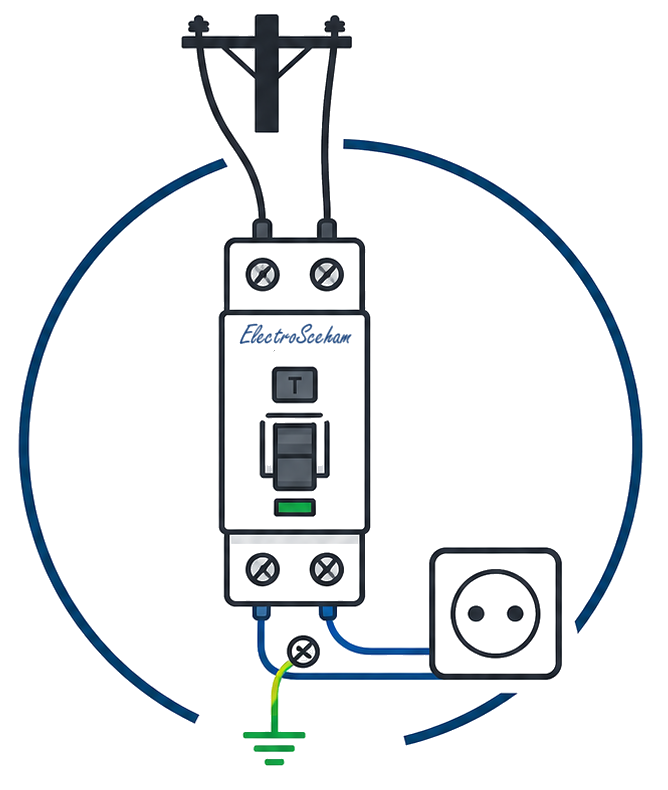
How an AFDD works
The AFDD (Arc Fault Detection Device) is the newest type of protective device in residential consumer units. It does not protect against overcurrent or residual current — it protects against fires caused by electrical arcs, hazards invisible to the MCB and the RCCB.
The problem the AFDD solves
Electrical arcs at loosened connections or damaged insulation are one of the mechanisms by which an installation sets fire to the materials around it. The current flowing through a series arc is usually below the MCB rated current — an arc of a few amperes on a circuit with an MCB rated at 16A trips nothing. The RCCB does not trip either, because the currents in L and N are equal. The arc burns silently for hours, overheating the surrounding combustible materials.
Common causes of arc faults in residential installations:
- Conductors pinched under a screw or by furniture (insulation damage)
- Loose connections in junction boxes, consumer units or sockets (intermittent contact)
- Cables damaged during renovations (drilling, mechanical abrasion)
- Worn insulation on old cables or on flexible runs
- Rodents gnawing through cable insulation
- Moisture penetrating junction boxes or sockets
- Sockets with faulty or incorrectly fitted plugs
What an arc fault is
An electrical arc is a continuous electrical discharge through a gaseous medium — the ionised plasma can reach over 6,000°C in low-voltage installations, enough to ignite any nearby combustible material immediately. Arc faults occur in three forms:
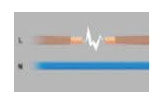
A single damaged conductor.
Below 20A — the MCB does not react.
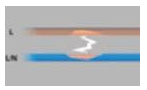
Compromised insulation between line and neutral.
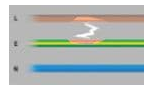
Arc between line and the protective conductor.
Fig. 1 — The three types of arc fault detected by the AFDD
The difference from a “normal” arc (the one when an MCB or relay opens):
- The switching arc (MCB, relay): lasts a few milliseconds, the arc chute controls it intentionally
- The arc fault: persistent, intermittent, appearing in unexpected places (junction boxes, sockets, behind appliances), impossible to extinguish without cutting the current
How the AFDD detects the arc
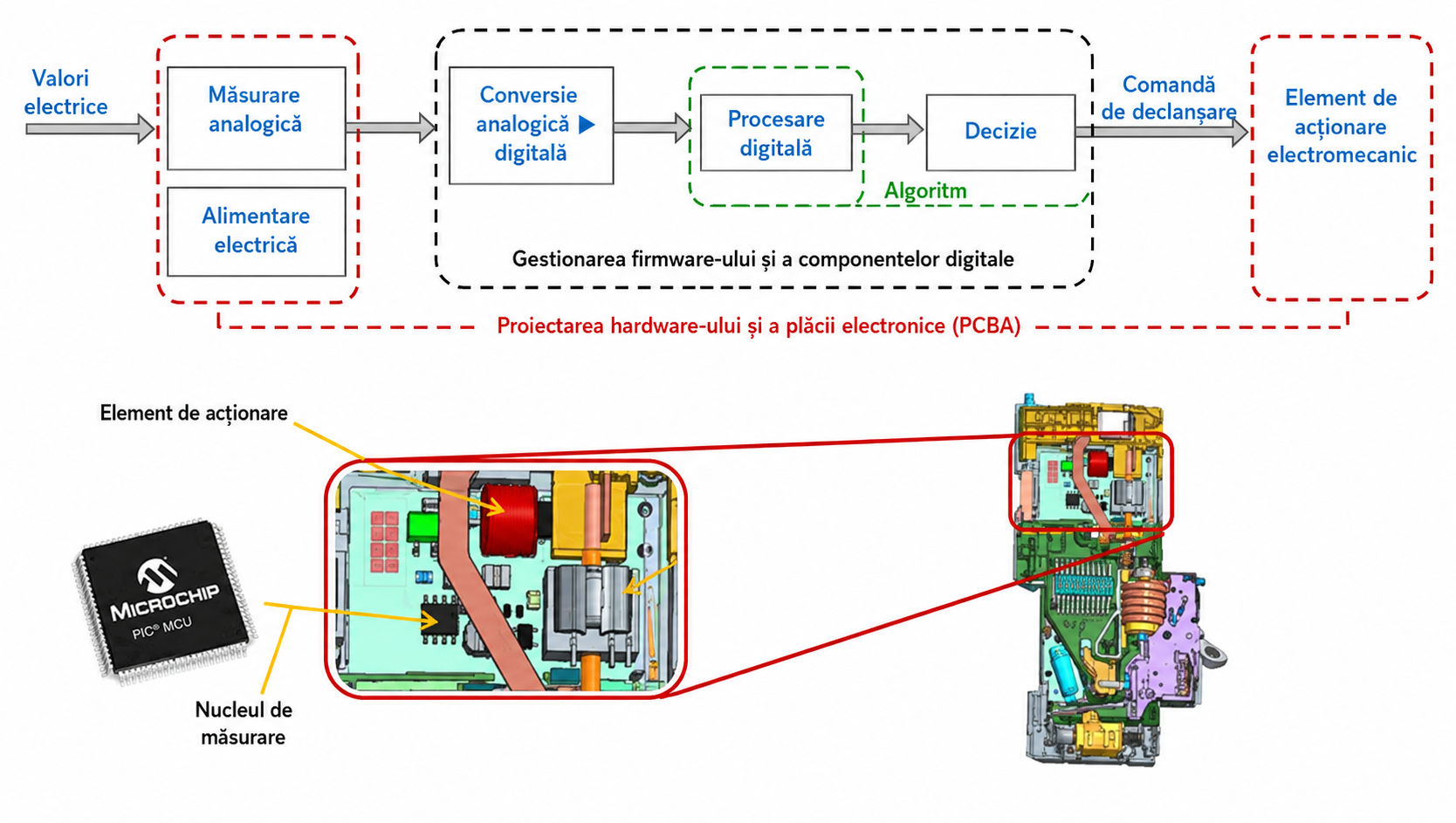
The fundamental principle: an electrical arc generates high-frequency electromagnetic noise (100 kHz – 1 MHz) superimposed on the 50 Hz sine wave. This noise appears especially at the zero-crossing transitions of the sine wave — the moment at which the arc can re-ignite. The AFDD picks up the circuit current through a current transformer (CT or Rogowski coil), filters out the 50Hz component and digitally analyses what remains.
A DSP (Digital Signal Processor) runs pattern-matching algorithms that recognise the signature of an arc and distinguish it from the noise of normal loads (dimmers, motors, switched-mode supplies). If the signature matches an arc fault, the AFDD commands immediate tripping of the circuit.
The internal structure of an AFDD
A compact AFDD with a combined function (AFDD + RCBO) integrates several distinct physical mechanisms:
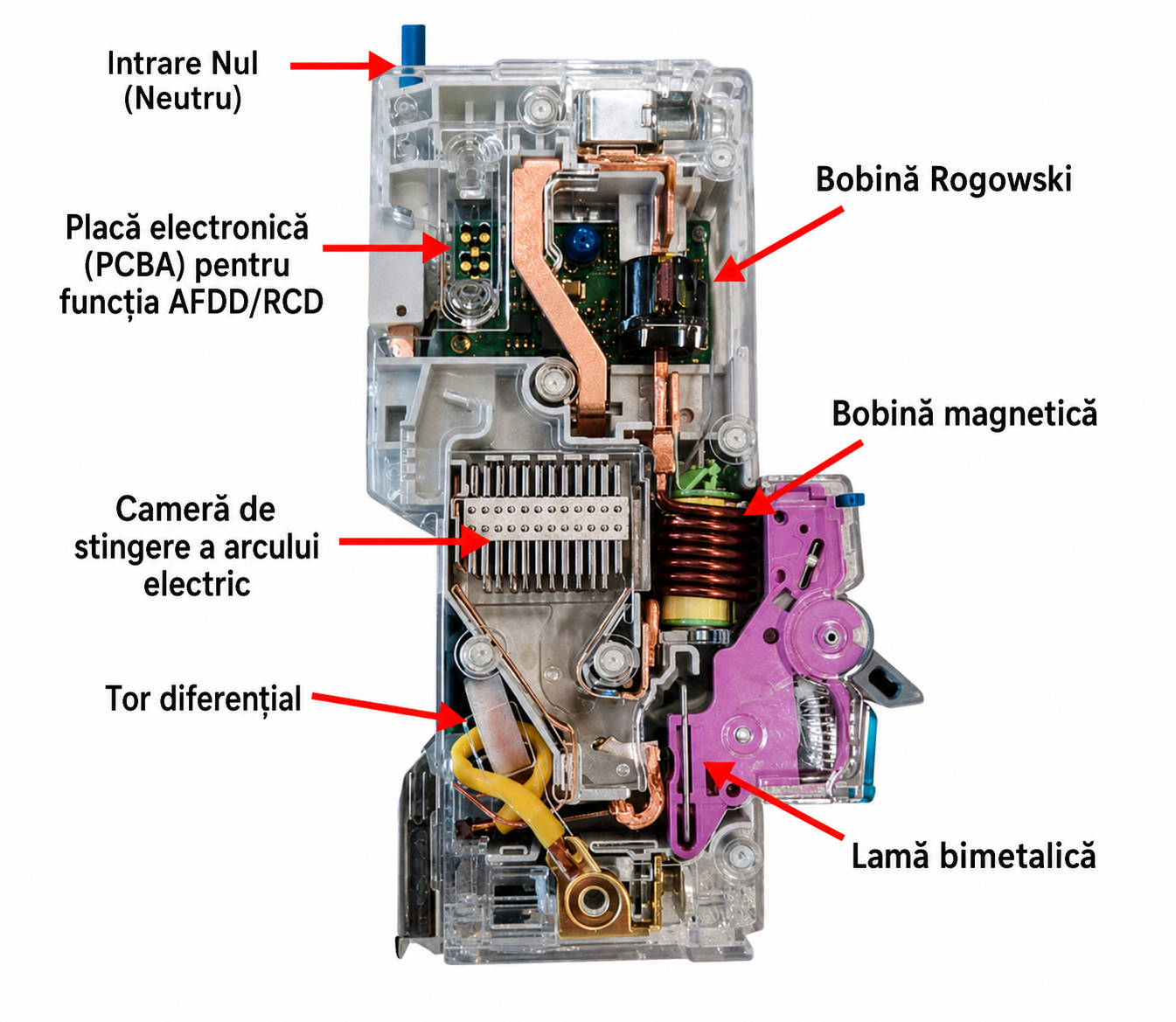
The key components in a modern AFDD:
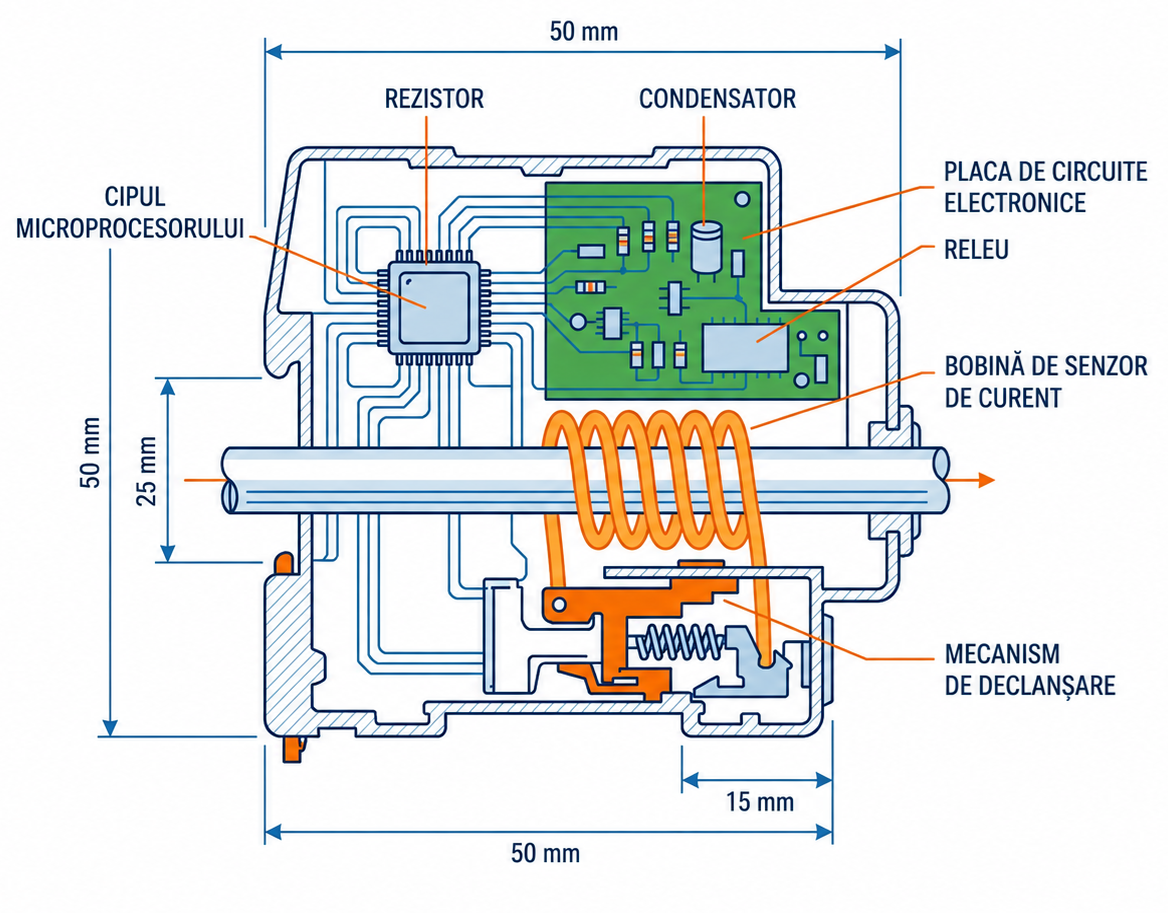
- The Rogowski coil — a current sensor with a response in the HF range (100kHz–1MHz); it captures the arc signature without being saturated by the mains-frequency current
- The PCBA board with a DSP microprocessor — performs the analogue-to-digital conversion and runs the detection algorithm, which tells the arc signature apart from the noise of ordinary loads
- The tripping relay — commanded by the microprocessor; it disconnects the circuit within a few tens of milliseconds
- The residual current toroid (in combined versions) — detects the 30mA residual current, identical to that in an RCCB/RCBO
- The bimetallic strip (in combined versions) — thermal tripping on overloads, identical to that in an MCB
- The arc chute — extinguishes the switching arc on disconnection, as in any MCB
Disconnection times according to IEC 62606
The IEC 62606 standard (SR EN 62606 in Romania) imposes maximum disconnection times depending on the arc current — the stronger the arc, the faster the AFDD must react:
| Arc current | Maximum disconnection time | Note |
|---|---|---|
| 2.5 A | 1.0 second | Weak arc, the MCB does not react |
| 5 A | 0.5 seconds | Moderate arc, still invisible to a 16A MCB |
| 10 A | 0.25 seconds | High energy — ignition risk |
| 32 A | 120 milliseconds | Series arc at high current (load close to In) |
The standard calculates the total arc energy to assess the fire risk. The AFDD does not act on the first “suspicion”, but only after the accumulated energy exceeds the danger threshold — preventing false alarms from accidental sparks. The full table in the standard has two more steps: 16 A → 0.15 s and 63 A → 0.12 s. All values concern the series arc, whose current is limited by the load. The parallel arc (line–neutral or line–PE) is tested separately, at much higher prospective currents, with a criterion based on the number of arcing half-cycles within a given interval.
The challenge of false alarms
The key problem in designing an AFDD is avoiding false alarms. Some normal loads generate HF noise similar to an arc:
- Dimmers (triac) — chop the sine wave at a controlled angle, generating HF
- Electric motors — sparks at the commutator (brush) or at the starting-relay contacts
- Switched-mode supplies (SMPS) — operate at tens to hundreds of kHz by design
- Hair dryers, vacuum cleaners — universal motor with brushes
- Inverters and fast chargers — abrupt voltage transitions
IEC 62606 does not set a statistical false-alarm rate. Immunity is verified by tests with typical loads — vacuum cleaner, triac dimmers, switched-mode power supplies, tools with universal motors — and by masking tests, in which the arc must still be detected while those loads are running. How exactly the device tells the arc apart from their noise is down to each manufacturer’s algorithm.
Integration variants in the consumer unit
SR EN 62606, referred to by the 2023 updates (point 4.1.5.8.3), describes three constructions: a) a single device fitted with a system that opens the protected circuit; b) a single device that integrates a protective device — a circuit breaker to SR EN 60898-1 or an RCD to SR EN 61008-1, SR EN 61009-1, SR EN 62423; c) a separate unit assembled on site with a declared protective device. In the consumer unit they usually turn up as the products below:
| Type | Included protections | DIN modules |
|---|---|---|
| Standalone AFDD — variant a) | Arc fault detection only — requires a separate MCB upstream | 1 module + separate MCB |
| AFDD + MCB (integrated) — variant b) | Arc fault + overcurrent + short circuit | 2 modules |
| AFDD + RCBO (integrated) — variant b) | Arc fault + 30mA residual current + overcurrent — full protection | 2 modules (compact) |
| On-site assembled AFD module — variant c) | Arc detection, assembled on site with the protective device declared by the manufacturer | 1 module + the declared device |
The AFDD + RCBO variant is the most complete: a single 2-module device provides protection against arcs (AFDD), electric shock (RCD 30mA) and overcurrents (MCB). It replaces three separate devices and saves space in the consumer unit.
Where it is recommended/mandatory
The IEC 60364-4-42 standard (clause 421.7) recommends an AFDD on AC final circuits in:
- Bedrooms — cables hidden in walls, combustible materials (mattresses, carpets, curtains)
- Living rooms and offices — not on the standard’s list, but worth considering as a design recommendation: a high density of appliances, heavily loaded sockets
- Buildings with combustible framing — timber houses, attics, lofts
- Areas with a high fire risk — warehouses with flammable materials, collections of irreplaceable goods
- HMO-type dwellings (Houses in Multiple Occupation) and student halls of residence — an example from the British regulations BS 7671 (A2:2022), not from IEC 60364-4-42
- Tall residential buildings (over 18m or 6 storeys) — a UK regulation since 2022, a model for future European updates
Normative reference — the 2023 updates
The international standard for AFDDs is IEC 62606 (SR EN 62606 in Romania), which defines the performance requirements, the test methods and the detection thresholds.
The 2023 updates to I7-2011 (MDLPA Order no. 959/2023, Monitorul Oficial no. 512 of 12 June 2023) make the AFDD mandatory. Art. 4.2.2.10 requires it, “as a special measure”, on all AC circuits with a rated current of no more than 32 A in the rooms fitted out for sleeping in residential buildings — sockets and lighting alike. The same obligation applies to accommodation units, crèches, kindergartens, primary schools and timber-framed buildings of fire-stability level III–V. Art. 4.2.2.11 exempts the circuits of equipment with a fire-safety role, and Art. 4.2.2.12 requires the AFDD to be installed at the origin of the circuit it protects.
In an ordinary home, this means an AFDD on every circuit serving a bedroom, sockets and lighting alike. Living rooms and offices are not on the list; there the AFDD remains the designer’s choice.
ElectroSchema
In ElectroSchema you can already place an AFDD on individual circuits in the visual consumer unit, with its own properties (rated current, curve, poles, ΔI). The protection assistant proposes it automatically for bedrooms, and rule V17 automatically warns about bedroom circuits without an AFDD, in line with the 2023 updates to I7-2011.
Discussion
Comments are moderated before publication. Your email is not displayed publicly.