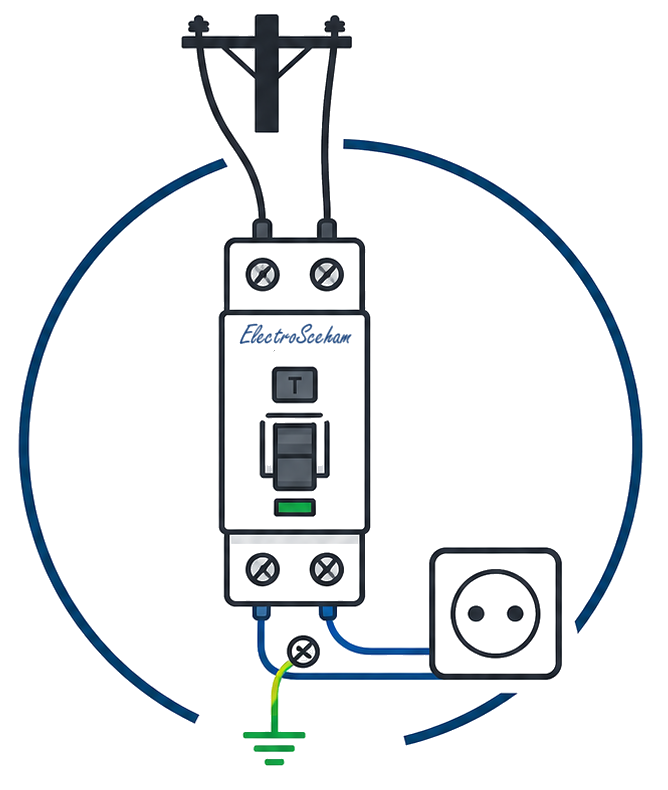
I7 compliance exercises
Pre-built projects with deliberate normative mistakes — incorrect cable cross-sections, high-power appliances on a shared circuit and a water heater without a dedicated circuit. You correct them on the plan, run the application’s real I7 validator and receive a score on the rules.
Circuit validator
Configure a circuit → verdict on rules V01 (cross-section), V06 (Ib ≤ In ≤ Iz) and V05 (RCD)
I7 compliance check
✓ CompliantDesign current Ib
10.2 A
Cable Iz
23 A
Minimum cross-section
2.5 mm²
Verdict identical to the app engine: the same thresholds, the same Iz table and the same Ib formula. Ib is computed single-phase, at 230 V and cos φ 0.85 — for a three-phase load use the circuit designer on the Design page. For a dedicated load, the 1.5 mm² minimum is the one for power circuits (Annex 5.32, row 1.3); if you connect it through a socket outlet, the minimum for single-phase socket circuits applies, 2.5 mm² (Art. 5.4.6 + Annex 5.32, row 1.2).
Board audit (find the errors)
An apartment board with deliberate mistakes — mark each circuit
The board below has 6 circuits. Some are correct, others hide a normative error (cross-section too small, In > Iz or missing RCD). Mark each circuit “Compliant” or “Error”, then press “Check audit” to see your score and the rule breached.
| Circuit | Cross-section | In | RCD | Your verdict |
|---|---|---|---|---|
| Bedroom lightingLighting | 1.5 mm² | 10 A | 30 mA | |
| Living room socketsSockets | 1.5 mm² | 16 A | 30 mA | |
| Water heater (dedicated)Dedicated load | 2.5 mm² | 16 A | 30 mA | |
| Bathroom socketsBathroom sockets | 2.5 mm² | 16 A | no RCD | |
| Kitchen socketsSockets | 2.5 mm² | 25 A | 30 mA | |
| Hallway lightingLighting | 1.5 mm² | 10 A | 30 mA |
Calculation assumptions and scope
- Thresholds identical to the application validator: minimum cross-section: sockets 2.5 mm² (Art. 5.4.6 + Anexa 5.32), lighting 1.5 mm² (Art. 5.4.4 + Anexa 5.32), motor 4 mm² (engineering recommendation, Art. 5.4.9 + subchap. 5.2.4); coordination Ib ≤ In ≤ Iz (Art. 4.3.2.1.3); RCD ≤ 30 mA on sockets/lighting (Art. 4.1.5.2.1, amended by Actualizări 2023) and in bathrooms (Art. 7.1.3.5)
- The design current Ib is estimated with Ib = P / (230 × cos φ), cos φ = 0.85 (the same convention as rule V06 in the validator); for real cases use the load’s power factor
- The current-carrying capacities Iz are those from Annex 5.10 of I7-2011, method B2 (cable in conduit, on or in the wall), PVC insulation, conductor 70 °C, ambient 30 °C, on the column with 2 loaded conductors — Ib is calculated single-phase. They are the same values the app’s validator (V06) uses for a 1P+N circuit
- This page covers the most common error classes; a real project is validated in full against every V rule in the ElectroSchema validator catalogue
Go deeper on the blog
Normative errors — step by step
From minimum cross-sections to protection coordination, RCD, SPD and AFDD.
A. What “normative errors” means
A project with deliberate mistakes
A project can “look” complete (rooms, sockets, board) and still breach the norm: cross-sections too small, undersized protections, missing RCD in bathrooms. These mistakes are not visible to the eye — they are caught by checking each circuit against the I7 rules.
The role of the validator
The app’s I7 validator automatically runs every V rule in the catalogue and flags each deviation with the article breached. On this page you practise the same checks manually, so you can recognise them quickly in real projects.
B. Minimum cross-sections by circuit type (V01 / V20)
Each circuit type has a minimum cross-section below which you must not go, regardless of the calculated current. It is the first check of any audit.
| Circuit type | Minimum cross-section | I7 article |
|---|---|---|
| Lighting | 1.5 mm² | Art. 5.4.4 I7-2011 |
| Sockets | 2.5 mm² | Art. 5.4.6 I7-2011 |
| Power (motive) circuit / three-phase | 1.5 mm² Cu (code) · 2.5 / 4 mm² (rec.) | Annex 5.32, row 1.3 I7-2011; 2.5 and 4 mm² are recommendations (V20) |
C. The coordination Ib ≤ In ≤ Iz (V06)
The three quantities must “fit” in order
Ib ≤ In ≤ Iz
Ib = the design current of the circuit; In = the rated current of the protection; Iz = the current-carrying capacity of the cable. The protection must be larger than the load, but smaller than what the cable can carry.
The two typical errors
If Ib > In, the protection trips at normal load (undersized). If In > Iz, the cable can overheat before the protection trips — the most dangerous case.
| Cu cross-section (mm²) | 1.5 | 2.5 | 4 | 6 | 10 | 16 |
|---|---|---|---|---|---|---|
| Iz B2, 2 loaded cond. (A) | 16.5 | 23 | 30 | 38 | 52 | 69 |
| Iz B2, 3 loaded cond. (A) | 15 | 20 | 27 | 34 | 46 | 62 |
Art. 4.3.2.1.3 — I7-2011
“Ic ≤ IN ≤ Iadm” — the design current ≤ the rated current of the protective device ≤ the current-carrying capacity of the conductor.
D. Residual current protection RCD (V05 / V18)
Where it is mandatory
Circuits of general-use socket outlets and current-using equipment with In ≤ 32 A, mobile equipment for outdoor use ≤ 32 A and, in single-family dwellings, lighting circuits are protected by an RCD ≤ 30 mA (Art. 4.1.5.2.1, amended by the 2023 updates). In bathrooms, all circuits (Art. 7.1.3.5).
The classic mistake: 300 mA on a socket
A 300 mA RCD reduces the risk of fire and can provide disconnection on a fault, but it does not deliver additional protection: only for one of at most 30 mA does the norm state that “the use of an RCD having a rated residual operating current not exceeding 30 mA is recognised as additional protection in the case of basic protection and/or fault protection or of carelessness by users” (Art. 4.1.5.2.2), and Art. 4.1.5.2.3 adds that even that one does not take the place of a protective measure. A socket circuit protected only by 300 mA is non-compliant.
Art. 4.1.5.2.1 — I7-2011 (amended by the 2023 updates, point 12)
“In alternating-current systems, additional protection shall be provided by a residual current device (RCD) not exceeding 30 mA for (per the recommendations of SR HD 60364-4-41): — general-use socket outlets and/or current-using equipment with a rated current not exceeding 32 A; — mobile equipment for outdoor use with a rated current not exceeding 32 A; — for lighting circuits, in single-family dwellings.”
E. Overvoltages (SPD) and electric arc (AFDD)
SPD in the main board
Protection against overvoltages is carried out “in stages, starting from the entry into the building” (Art. 4.4.2.1), and the first stage sits in the main board — usually a type 2 SPD, a choice of practice, not the letter of the code. Exception: where the supply comes from an entirely underground cable network, protection against lightning overvoltages is not required (Art. 4.4.2.3). A missing SPD is flagged by rule V15.
AFDD on bedrooms (2023 Amendments)
The 2023 Amendments to I7 introduce AFDD (arc fault detection device) on final circuits ≤ 32 A in bedrooms, against fires of electrical origin. Rule V17 checks them.
Art. 4.4.2 / 4.4.3 (SPD) · Art. 4.2.2.10 + 4.1.5.8 Actualizări 2023 (AFDD)
Overvoltage protection is provided by SPD devices (Art. 4.4.2, 4.4.3). The 2023 updates introduce the AFDD: Art. 4.1.5.8 defines it, and Art. 4.2.2.10 makes it mandatory on final circuits ≤ 32 A in the sleeping accommodation of residential buildings (NOT Art. 4.1.5.2.1, which governs the 30 mA RCD).
F. How the ElectroSchema validator works
Every V rule, a score and an error list
On each project, the validator runs every V rule in the catalogue, groups deviations by severity (error / warning) and cites the exact article. You correct, re-run and watch the number of errors fall.
Error vs warning
An error (e.g. Ib > In: the load exceeds the rating of the protective device) blocks compliance; a warning (e.g. In > Iz, sockets without an RCD, missing SPD, voltage drop at the limit) is still a deviation to correct before execution, it just does not block the score. The target of a good project: zero errors and zero warnings on the protective devices.
Fix the I7 deviations in the project
A project with planted errors. Adjust the parameters (cable cross-section, circuit type) until the deviations clear — checked by the app’s real I7 engine.
Kitchen with 2 deviations
The socket-outlet circuit and the water heater don’t comply with I7. Adjust the parameters on the right until the plan no longer has any deviations.
Deviations remaining: 2
Secțiune cablu insuficientă pentru circuit prize
Boiler fără circuit dedicat
Bathroom + living room with 2 deviations
The washing machine and one socket-outlet circuit have problems. Correct them.
Deviations remaining: 2
Secțiune cablu insuficientă pentru circuit prize
Aparate > 2 kW pe circuit comun
Apartment with 6 deviations
Three socket-outlet circuits have undersized cable, and the water heater and the washing machine sit on a shared circuit even though above 2 kW they require a dedicated one (Art. 5.3.2.3 and 5.4.7). Correct all the deviations until the plan complies with I7.
Deviations remaining: 6
Secțiune cablu insuficientă pentru circuit prize
Secțiune cablu insuficientă pentru circuit prize
Secțiune cablu insuficientă pentru circuit prize
Aparate > 2 kW pe circuit comun
Aparate > 2 kW pe circuit comun
Boiler fără circuit dedicat
Consumer unit without SPD + bedroom without AFDD
The consumer unit has no surge protective device (SPD), and the bedroom socket-outlet circuit has no AFDD. Add the SPD (I7-2011, Art. 4.4.2.1 / 4.4.3) and the AFDD on the bedroom circuit (Art. 4.2.2.10, Actualizările 2023).
Deviations remaining: 2
Lipsă dispozitiv de protecție la supratensiune (SPD)
Circuit dormitor fără AFDD (detector arc electric)
Bathroom downlight with insufficient IP rating
The downlight in zone 2 of the bathroom (next to the bathtub) has IP20 — too low for a space exposed to water splashes. Choose the correct IP rating for the zone.
Deviations remaining: 1
IP insuficient față de zona 2 (necesar IPX4)
Exercises — choose the correct option
You go through each step by choosing the correct answer. Wrong? Try again.
Sockets with the wrong cross-section
A single-phase socket circuit has 1.5 mm² Cu cable, protected by a 20 A MCB.
Step 1: What is the first error?
Bathroom without RCD
A bathroom socket circuit is protected by a 16 A MCB, with no RCD at all.
Step 1: What is mandatory and missing?
In above Iz
Single-phase circuit, 2.5 mm² Cu cable (Iz = 23 A), protected by a 25 A MCB.
Step 1: The condition In ≤ Iz is...?
Undersized motor
A single-phase pump (motor) is supplied on 2.5 mm² cable.
Step 1: What cross-section is recommended for a pump or motor circuit?
Exercises — you calculate each step
You enter the value for each step yourself. You get hints if you go wrong.
Ib and Iz — you calculate
Single-phase load 2000 W (cos φ = 0.85), 2.5 mm² Cu cable.
Step 1: Design current Ib = P / (230 × cos φ) = ?
Minimum cross-section for sockets
You must choose the minimum cross-section of a socket circuit, regardless of current.
Step 1: Minimum cross-section (mm²) = ?
Iz and the margin relative to In
Single-phase lighting circuit, 1.5 mm² Cu cable, 10 A MCB.
Step 1: Iz for 1.5 mm² Cu = ?
Exercises — direct answer
You solve it on your own and give the final answer. The step-by-step solution is available if needed.
Minimum socket cross-section
What is the minimum cross-section (mm², Cu) for a socket circuit?
Iz for 4 mm² Cu
What is the current-carrying capacity Iz (A) of a 4 mm² Cu cable on a single-phase circuit, per the table the app uses?
Design current Ib
Single-phase load 3000 W, cos φ = 0.85. What is Ib (A)?
Discussion
Comments are moderated before publication. Your email is not displayed publicly.