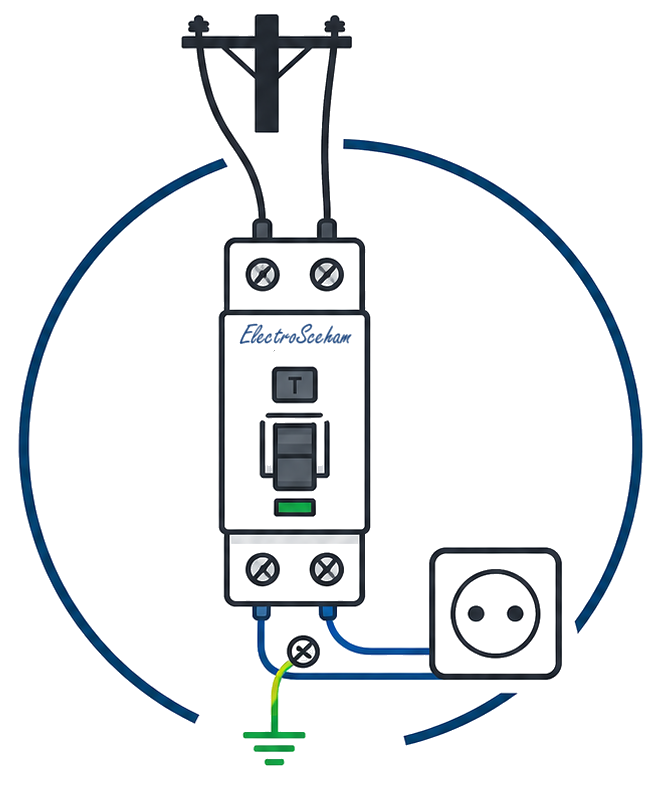
What happens with the consumer unit the client asked for
The client wants the cheapest consumer unit: the big appliances on a single breaker, no RCD, single-pole breakers. Pick the home, tick what they asked for and watch, situation by situation, what happens in the house.
The consumer unit
What the client asked for
Adjust the consumer unit row by row
The choices above rebuild the typical consumer unit for the home. Here you change each row.
| Row | What it supplies | Breaker | Poles | Cable | AFDD |
|---|---|---|---|---|---|
| F1Lights | Light · BedroomLight · Living roomLight · KitchenLight · Bathroom | ||||
| F2Room sockets | Heater (socket) · BedroomTV · Living room | ||||
| F3Kitchen sockets | Fridge · KitchenKettle (socket) · Kitchen | ||||
| F4Big appliances | Oven · KitchenWater heater · BathroomWashing machine · Bathroom |
Situations in this consumer unit
- 1The wire overheatsAparate > 2 kW pe circuit comun · Curent estimat depășește curentul nominal al protecției · Curent nominal MCB depășește capacitatea admisibilă a cablului (In > Iz) · Water heater without a dedicated circuit
- 2Live casingPriză protejată fără diferențial · Distribution board with MCBs but no RCD · Fixed appliance without residual current protection
- 3Loose terminalBedroom circuit without AFDD (arc fault detection device)
- 4Breaker switched offSingle-pole (1P) protective device on a single-phase circuit
What the validation finds, with the articles
The same rules as in the editor’s Diagnostics, only the ones the situations above show.
- ErrorAparate > 2 kW pe circuit comunV04 · Art. 5.4.7 + Art. 5.3.1.1 I7-2011
- ErrorCurent estimat depășește curentul nominal al protecției · Big appliancesV06 · Art. 4.3.2.1.3 I7-2011
- WarningPriză protejată fără diferențial · Heater (socket)V05 · Art. 4.1.5.2.1 I7-2011
- WarningPriză protejată fără diferențial · Kettle (socket)V05 · Art. 4.1.5.2.1 I7-2011
- WarningCurent nominal MCB depășește capacitatea admisibilă a cablului (In > Iz) · Big appliancesV06 · Art. 4.3.2.1.3 I7-2011
- WarningBedroom circuit without AFDD (arc fault detection device) · LightsV17 · Art. 4.2.2.10 Actualizări 2023 I7-2011
- WarningBedroom circuit without AFDD (arc fault detection device) · Room socketsV17 · Art. 4.2.2.10 Actualizări 2023 I7-2011
- WarningDistribution board with MCBs but no RCD · Main consumer unitV33 · Art. 4.1.5.2.1 I7-2011
- WarningWater heater without a dedicated circuit · Water heaterV40 · Art. 5.3.1.1 I7-2011
- WarningFixed appliance without residual current protection · OvenV77 · Art. 4.1.5.2.1 I7-2011 (modif. Actualizări 2023)
- WarningFixed appliance without residual current protection · Water heaterV77 · Art. 4.1.5.2.1 I7-2011 (modif. Actualizări 2023)
- WarningFixed appliance without residual current protection · Washing machineV77 · Art. 4.1.5.2.1 I7-2011 (modif. Actualizări 2023)
- WarningSingle-pole (1P) protective device on a single-phase circuit · LightsV78 · Art. 5.3.4.0.3 I7-2011
- WarningSingle-pole (1P) protective device on a single-phase circuit · Room socketsV78 · Art. 5.3.4.0.3 I7-2011
- WarningSingle-pole (1P) protective device on a single-phase circuit · Kitchen socketsV78 · Art. 5.3.4.0.3 I7-2011
- WarningSingle-pole (1P) protective device on a single-phase circuit · Big appliancesV78 · Art. 5.3.4.0.3 I7-2011
It has happened before
Real incidents, from news reports citing ISU or reported by electricians, with the conditions that led to them. We show how many of those conditions are also in the consumer unit above, not a probability.
For context: in the first 8 months of 2026, IGSU counted 1,376 home fires caused by faulty electrical installations, out of 4,732 (figures quoted by Știrile ProTV, 23.09.2026).
IGSU daily report for October 19, 2026: 1,816 firefighter interventions across Romania, including 86 fires. The daily report gives only national totals, with no causes and no figure for homes. (igsu.ro)
Firefighters’ press releases about interventions, on IGSU’s Facebook page →We don’t yet have an incident on record with the same conditions as the consumer unit above.
Found a case like this on site? Report it →Where the numbers come from
- The wire’s current-carrying capacity (Iz) is taken from I7-2011, Annex 5.10, copper, PVC, installation method B2, at 30 °C: 16.5 A for 1.5 mm², 23 A for 2.5 mm². These are the same values used by rule V06 in the app.
- Wire temperature: θ ≈ 30 + 40·(I/Iz)², reached with a time constant of about 5 minutes. Time runs faster than in reality. An appliance’s current is P/U, what a resistive load actually draws; for appliances with a motor or electronics the real current is somewhat higher.
- The breaker (SR EN 60898-1): does not trip below 1.13·In and is certain to trip within one hour from 1.45·In. In between, the simulation does not make it trip, because the standard does not require it. The moment of tripping is illustrative.
- The RCD (SR EN 61008-1): is certain to trip from IΔn, within 0.3 s at most, and does not trip below 0.5·IΔn. In the simulation, 45 mA flows through the person: an illustrative value, for dry hands; with wet hands or bare feet the current is much higher. To protect people, Art. 4.1.5.2.1 (2023 version) requires an RCD of at most 30 mA.
- A series arc does not leak current to earth, so the RCD does not see it (Art. 4.1.5.8.2 letter a), 2023 Amendments). AFDD in bedrooms: Art. 4.2.2.10. Two-pole breakers on single-phase circuits: Art. 5.3.4.0.3. A separate circuit for each power load: Art. 5.3.1.1.
- Made up for the exercise: the home, how fast the socket chars, the moments of tripping, the current through the person and the live–neutral swap, which is a working assumption.
Discussion
Comments are moderated before publication. Your email is not displayed publicly.