Interactive exerciseBETA
Electrical panel simulator
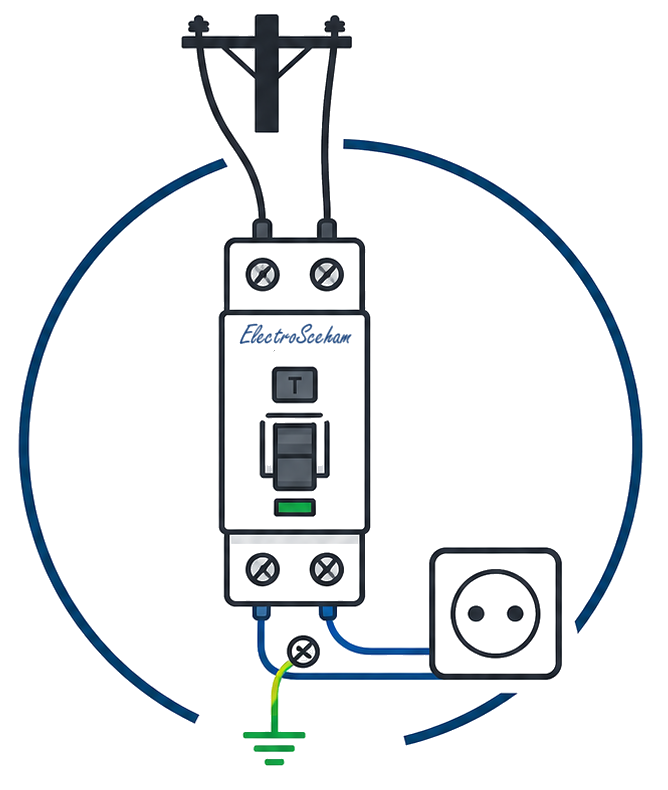
A single-phase panel that actually works: flip the levers, press the RCD TEST button, cause a short circuit or an overload and watch the breaker trip, with current flowing along the wires.
Device status
| Main | 0.00 A | |
| RCD | 0.00 A | |
| Lighting | 0.00 A | |
| Sockets | 0.00 A |
Log
Operate the panel to see events.
How it works
- A short circuit produces a huge current; the magnetic protection opens almost instantly once the current enters the curve’s tripping band — B = 3–5×In, C = 5–10×In, D = 10–20×In. Below the lower end it does not trip instantaneously, above the upper end it trips for certain, and in between tripping is uncertain. The simulator uses the upper end as the threshold.
- An overload (current above In, but not enormous) heats the bimetal; tripping is inverse-time — the larger it is, the faster it trips.
- The RCD compares the outgoing and returning current; if part of it “leaks” to earth (≥ IΔn, e.g. the TEST button), it opens both poles.
- Selectivity: a fault on one circuit trips only its own breaker, not the main one — the rest of the panel stays live.
Thermal times are sped up for teaching, so tripping is visible within a few seconds. Powered by a real MNA engine (computed current, not a pre-set animation).